

Sanctions screening with far fewer false positives.
Match every customer and payment against global sanctions lists in real time, and let entity resolution clear the noise so analysts act on true exposure.
Sanctions screening is non-negotiable, but name-only matching against global lists produces a flood of false positives that hides the real hits.
Spelling variants, homonyms and stale records mean one true risk can surface as dozens of matches, each of which a reviewer has to clear by hand.
How does BriteBase help with sanctions screening?
Our engine screens against OFAC, Canada, EU, UK, Australia and APAC sanctions lists, plus trade restriction lists, then agentic workflows resolve entities to collapse near-duplicate matches into one scored identity with a plain-language reason.
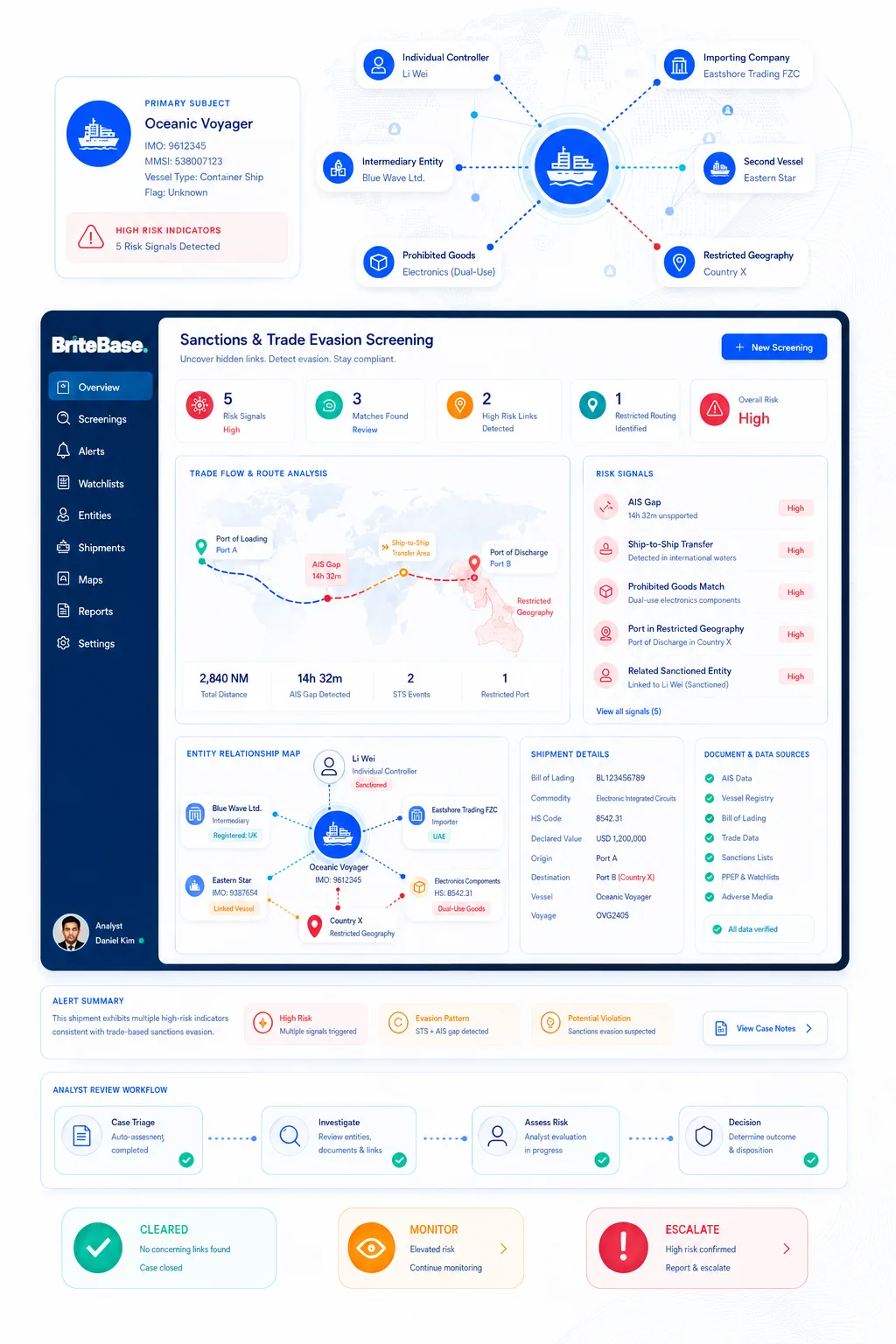
A party is screened against global sanctions lists in real time.
Raw matches are gathered across lists and variants.
Entity resolution scores identity coherence.
Near-duplicate false positives are cleared.
True hits are escalated with a rationale and citations.
What powers the workflow?
Global list coverage
OFAC, Canada, EU, UK, Australia and APAC.
Agentic entity resolution
Collapses duplicate matches.
Explainable hits
Each hit ships a reason.
Regular updates
Lists refreshed on a regular cadence.
Frequently asked questions
Which sanctions lists does BriteBase screen against?
The major sanctions regimes: OFAC in the US, Canada, the EU, the UK under OFSI, Australia and APAC jurisdictions, including comprehensively sanctioned geographies, vessels, ports and restricted securities, plus trade restriction lists such as the US BIS lists, the World Bank Listing of Ineligible Firms and Individuals, and the Canada Export Controls List. Screening runs on every customer and payment in real time rather than on a delayed or batch basis. Breadth of coverage matters because sanctions exposure is rarely confined to a single jurisdiction alone: a customer or counterparty can be clean against a domestic list while carrying exposure on a foreign one, particularly for cross-border payments or a customer base that spans multiple countries. Because this same list coverage also feeds company screening and payment screening, a party is checked against the same breadth of lists regardless of which screening surface triggered the check.
How does it reduce sanctions false positives?
Spelling variants, homonyms and stale records can turn one true risk into dozens of matches, since a common name can appear across multiple sanctioned individuals or entities, and transliteration differences alone can generate several spellings of what is actually the same listed party. Agentic entity resolution collapses these near-duplicate matches into one scored identity, designed to cut false positives by up to 80% without dropping the genuine hit hiding among them. This distinguishes resolution from simple fuzzy matching: fuzzy matching alone tends to produce more candidate matches, not fewer, because it is deliberately permissive about spelling variance, whereas resolution scores identity coherence across those candidates to determine which ones actually represent the same underlying party before a human ever has to adjudicate the difference between a coincidental homonym and a true, if imperfectly spelled, match.
Are sanctions hits explainable?
Yes. Each true hit is escalated with a plain-language rationale and source citations, for example an exact name and date-of-birth match against a specific listed entity, rather than a bare confidence score with no stated reasoning behind it. This is deliberate: a reviewer, and later an examiner, needs to understand specifically why a party was escalated, not just that an algorithm assigned it a high score, since a score alone cannot be defended in an examination the way a stated rationale can. The explanation is generated as part of the same entity-resolution process that clears the false positives around it, so the reasoning behind an escalated hit and the reasoning behind a cleared near-duplicate both draw from the same underlying evidence, keeping the two decisions consistent with each other rather than the product of two disconnected processes.
See sanctions screening in action with BriteBase.
See our platform screen a live customer against global sanctions, PEP and adverse media data. Book a demo with our team.