

A practitioner-built operating layer for compliance decisions.
BriteBase is a practitioner-built, AI-native AML screening and risk-intelligence platform. Enriched risk data, explainable screening and human-in-the-loop workflows reduce alert noise, accelerate investigations, and turn every decision into one a team can defend.
Our vision and mission.
To transform financial crime compliance, applying technology that removes friction and operational cost for regulated entities.
For too long, the industry has treated operational complexity as an unavoidable cost of compliance. Advances in technology combined with deep, practitioner-led expertise now make it possible to solve this problem.
To deliver an AI-native screening platform that improves risk detection and is designed to reduce false positives by up to 80%.
Enriched sanctions, trade restriction, PEP and adverse media data, agentic entity resolution and human-in-the-loop workflows put analyst attention on real exposure and keep every decision explainable at examination.
Replace stale data, siloed tools and manual workflows.
Traditional screening creates too much noise and not enough clarity. Compliance teams spend their day gathering evidence, comparing records and clearing low-value alerts instead of focusing on real risk. BriteBase was built to change that, designed to reduce false positives by up to 80% through enriched data, contextual matching and controlled workflow automation. Engineering teams can integrate directly through our self-serve screening API, compliance operations teams can manage alerts, investigations and monitoring through a unified platform with integrated case management, and organizations that run their own screening technology can subscribe to the watchlist data on its own.
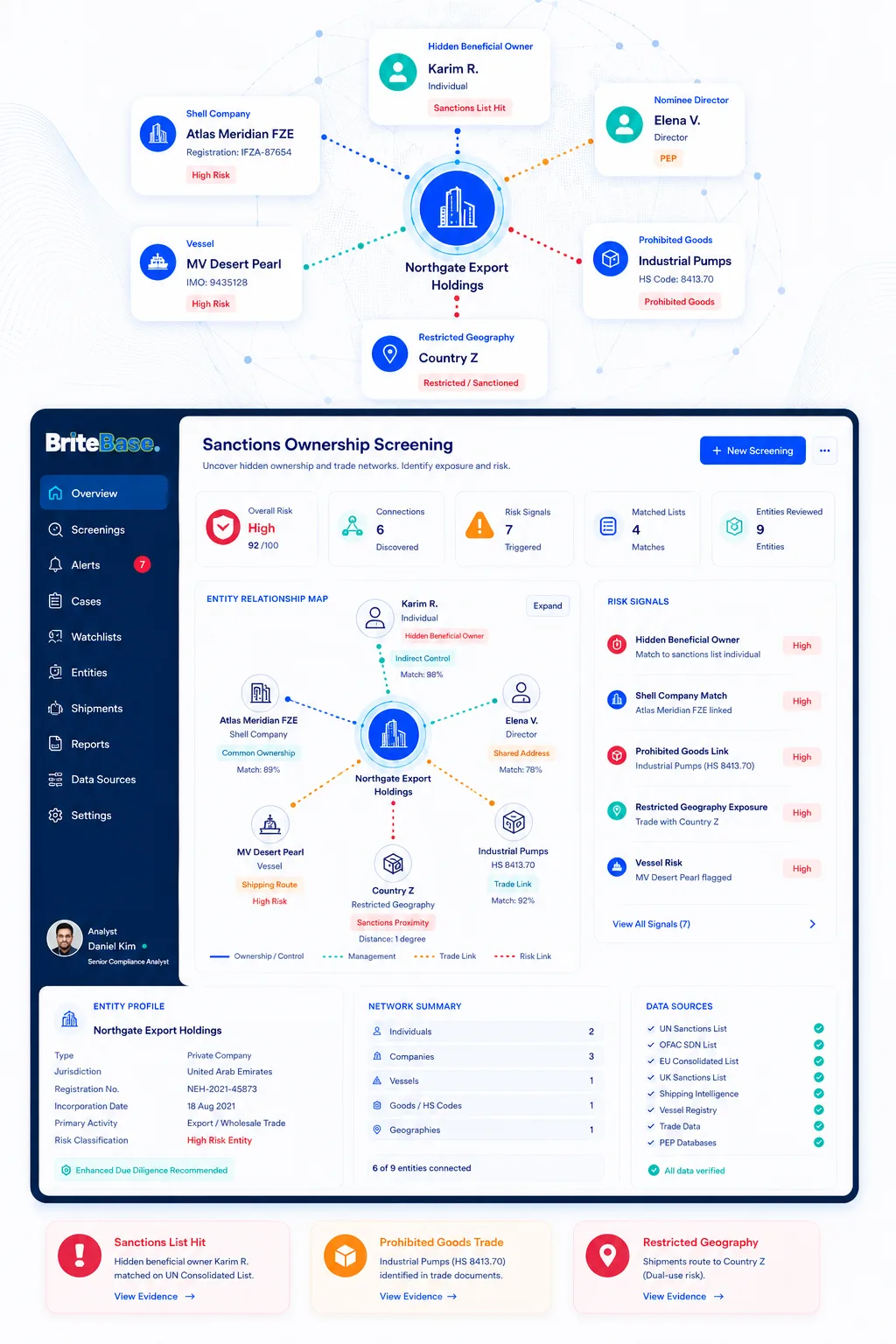
Built to reduce noise and stand up to examination.
Proprietary engines
We build our own screening and risk-data technology, tuned for precision and explainability rather than a reseller roadmap.
Fewer false positives
Entity resolution cuts screening noise without dropping true matches, designed to reduce false positives by up to 80%.
Explainable by default
Every decision carries a plain-language rationale and an evidence trail, ready for the examiner.
Human in the loop
Automation handles triage, routing and case preparation, while material compliance decisions stay subject to human review and approved policy.
Our screening system is profiled in AML Tech Reviews, a research directory covering financial crime technology vendors.
Questions about the BriteBase platform.
What does BriteBase do?
BriteBase is a practitioner-built, AI-native AML screening and risk-intelligence platform. It covers the four kinds of screening regulated entities are required to conduct: sanctions screening for customers and payments, trade risk screening for dual-use goods, AML screening for PEP, RCA and HIO exposure, and reputational risk screening against adverse media. Enriched data, explainable matching and human-in-the-loop workflow automation are designed to cut false positives by up to 80% while keeping every decision explainable. The platform is built around two connected products, the screening engine and the risk-intelligence data layer, sharing one entity-resolution engine rather than operating as disconnected tools that each generate their own uncoordinated alerts. It can be deployed three ways: self-serve through a REST screening API, through a unified compliance platform with integrated case management, or as watchlist data on its own for teams that already run their own screening. Reducing alert noise without losing real risk, while keeping an examiner-ready rationale on every decision, is the core problem BriteBase is built to solve.
How does BriteBase reduce AML false positives?
With traditional name-only screening, the vast majority of alerts are false positives, since spelling variants, transliterations and simple homonyms routinely cause one real customer to surface as several separate alerts across sanctions, PEP and adverse-media lists. Our screening system evaluates multiple attributes instead of relying on name similarity alone, and agentic entity resolution collapses near-duplicate matches into one scored identity before an analyst ever sees them, so review queues carry real risk instead of noise. It is designed to cut false positives by up to 80% as a result. This is not achieved by simply loosening match thresholds, which would risk dropping true hits along with false ones; resolution instead scores identity coherence across candidate matches to distinguish a genuine, if imperfectly spelled, match from a coincidental homonym. Every result still shows the matching and conflicting information behind the assessment, so noise reduction never comes at the cost of the explainability an examiner expects.
Can I use BriteBase as an API, a full platform, or data only?
All three, depending on which team is doing the integrating. Engineering and product teams can deploy self-serve through the BriteBase screening API, embedding screening into onboarding, customer monitoring or payment systems with structured responses and low implementation friction. Compliance operations teams, who typically want to work risk directly rather than build tooling around an API, can run alerts, investigations and monitoring in a unified compliance platform with integrated case management. Organizations that already operate their own screening technology can subscribe to the BriteBase watchlist data on its own, on coverage-based subscriptions. All paths draw on the same underlying entity-resolution engine and the same enriched data layer, so the false-positive reduction and explainability BriteBase is built around apply identically whichever way a team chooses to work with it; they are three delivery options for the same risk decisions, not different products with different logic.
Which industries does BriteBase serve?
Fintech is the primary focus, with coverage extending to banks, money services businesses (MSBs), crypto and digital-asset businesses (VASPs), payments companies, digital lenders, marketplaces and enterprise platforms. Each industry carries a different specific pressure on the same underlying screening problem: fintechs need to onboard in seconds while staying examiner-ready, banks carry large legacy books and heavy examination scrutiny, MSBs run heavy AML obligations on comparatively lean teams, and crypto platforms need travel-rule-ready screening that does not throttle transaction throughput. Rather than building industry-specific products from scratch for each of these, our platform applies the same core screening and data engine across all of them, configured to the volume, regulatory framework and risk profile each industry actually faces, so the false-positive reduction and audit-trail discipline are consistent across sectors even though the specific pressures driving the need for them differ.
Does BriteBase provide an audit trail for examiners?
Yes. Every hit ships a plain-language rationale, not just a bare confidence score, and alerts, evidence and dispositions are captured as one connected, audit-ready case history rather than scattered across the separate systems that touched a case along the way. Thin explanations, not thin screening coverage, are usually what actually lengthens an examination, whether the examiner is FINTRAC in Canada, FinCEN in the US, the FCA in the UK, or a national supervisor in the EU: an examiner can accept a clearly stated rationale far faster than a bare match score with no reasoning attached, and a connected record is far faster to produce on request than one that has to be reconstructed from multiple disconnected systems under examination-day time pressure. The same audit-trail structure applies consistently whether the underlying decision came from real-time onboarding screening or from ongoing monitoring picking up a change months later, so examiner-readiness is not limited to one particular workflow.
How is BriteBase different from traditional AML screening tools?
Traditional tools produce too much noise and not enough clarity: name-only matching floods queues with false positives, match scores arrive without explanation, and evidence for a decision is scattered across systems a team has to reconcile by hand. Our platform approaches the same problem from the data up. Enriched records carrying aliases, identifiers, relationships and ownership information give the matching logic something real to work with, contextual matching evaluates multiple attributes instead of name similarity alone, and human-in-the-loop automation handles triage, prioritization, routing and routine case preparation while material compliance decisions stay subject to human review and approved policy. The practical difference shows up in cases a name-only tool would miss entirely, such as a corporate structure whose sanctions exposure only appears once deep-tier ownership is traced under the 50% Rule, and in the ones it would overflag, where the conflicting evidence behind a cleared match is shown rather than silently discarded.
Talk to the team building defensible compliance.
See our platform screen a live customer against global sanctions, PEP and adverse media data. Book a demo with our team.