

Risk intelligence engineered for screening decisions.
The data layer behind agentic BriteBase screening: sanctions, trade restriction, PEP and adverse media records enriched with aliases, dates of birth, locations, identifiers, relationships, ownership information and source evidence. Available on coverage-based subscriptions for organizations that already operate their own screening technology.
Why is bad data the root of bad screening?
Stale lists, thin records and inconsistent structure are what generate false positives and missed risk downstream. The data has to be built for screening.
- 01
Stale lists
Data refreshed on a lag means screening against a yesterday view of the world.
- 02
Thin, unstructured records
Records without identifiers or context force reviewers to match by name alone.
- 03
Coverage gaps
Missing lists or regions leave exposure no one can see.
- 04
No explainability
When the data cannot show why something matched, the decision cannot be defended.
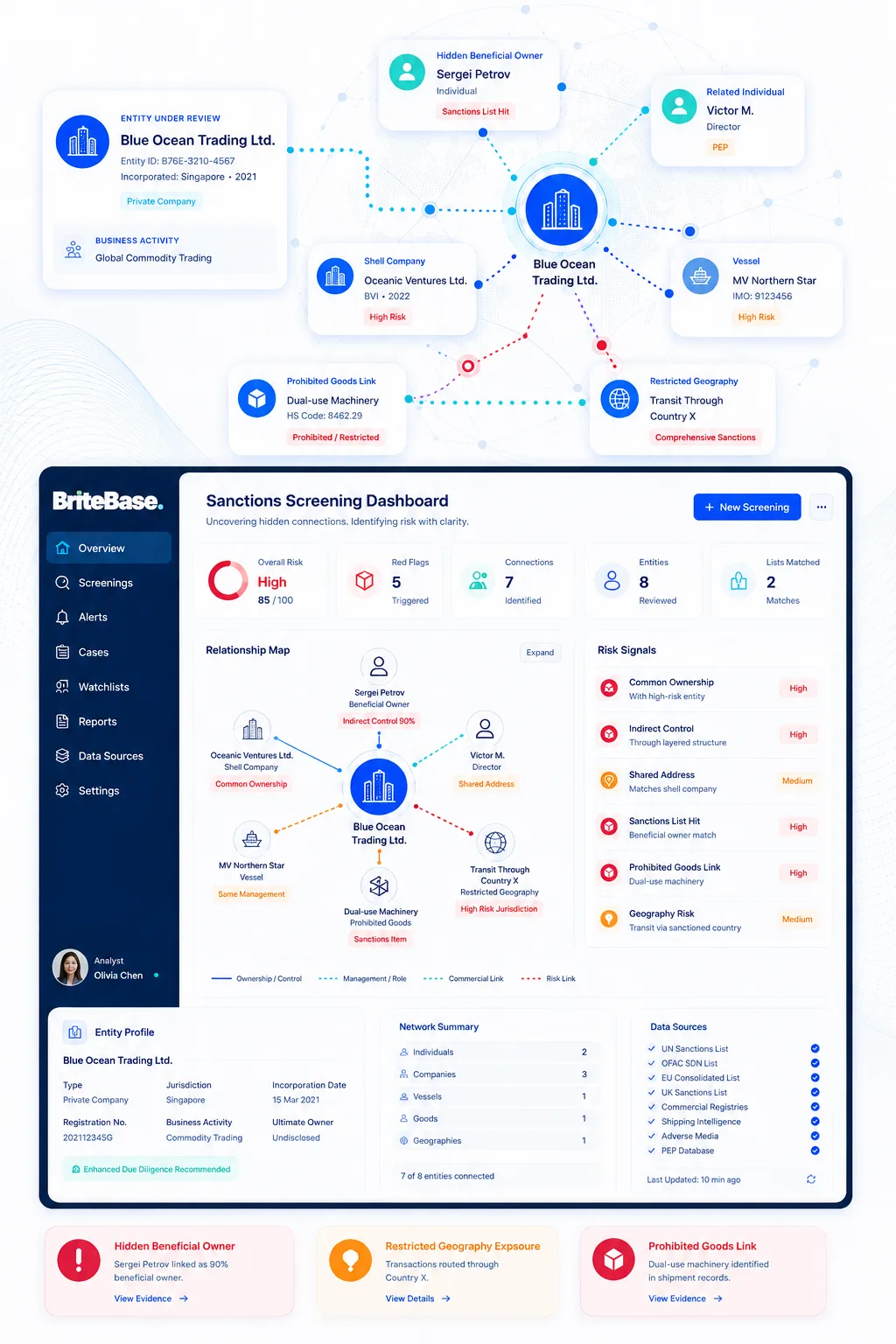
Data structured for accurate, explainable screening
Coverage, freshness and deep-tier structure that agentic workflows use to reduce noise and stand up at exam time.
Sanctions data
OFAC, Canada, EU, UK, Australia and APAC coverage, including comprehensively sanctioned geographies, vessels, ports and restricted securities.
Trade restriction lists
The US BIS lists, the World Bank Listing of Ineligible Firms and Individuals, and the Canada Export Controls List.
PEP, RCA and HIO data
Tiered politically exposed person data covering relatives, close associates and heads of international organizations.
Adverse media intelligence
Relevant negative news with citations, structured for screening.
Deep-tier ownership mapping
Trace beneficial ownership and close associate networks, including the 50% Rule, to close blind spots a name-only match would miss.
Regular updates
Records enriched with aliases, dates of birth, locations, identifiers, relationships and source evidence, refreshed regularly.
Why the data layer matters
The old way
The BriteBase way
Explainable, configurable and audit-ready
Built so every decision can be defended and every workflow tuned to your risk appetite.
Data quality and relevance
Structured and filtered to reduce noise, not add to it.
Data freshness
Regular updates keep screening current.
Citable evidence
Source citations support every adverse media result.
Frequently asked questions
What data does BriteBase provide?
Sanctions data spanning OFAC, Canada, the EU, the UK, Australia and APAC regimes, including comprehensively sanctioned geographies, vessels, ports and restricted securities, plus trade restriction lists such as the US BIS lists, the World Bank Listing of Ineligible Firms and Individuals, and the Canada Export Controls List. Alongside that sit tiered PEP data covering relatives, close associates and heads of international organizations, relevant adverse media with source citations attached to every finding, and linked entity data across aliases and connected parties, including deep-tier ownership structures affected by the 50% Rule. The reason these live together as one data layer, rather than separate feeds a screening tool has to reconcile itself, is that false positives and missed risk both tend to originate in bad or disconnected data upstream of the actual matching logic. This data structure is what our screening system consumes, and it is also available on coverage-based subscriptions as the risk-intelligence layer behind an existing screening stack.
What is the 50% Rule, and does BriteBase cover it?
The 50% Rule is the sanctions-attribution principle that an entity majority owned or controlled by a sanctioned party is itself treated as sanctioned, even when that entity is not separately named on any list. It exists precisely because sanctioned parties can and do route activity through subsidiaries, holding structures and nominee ownership that never appear on a watchlist directly, so a name-only screen against the parent list alone would miss the exposure entirely. Our data layer maps deep-tier ownership and close associate networks so that this kind of exposure surfaces even when the sanctioned party is several ownership layers removed from the entity actually being screened. This is structured as part of the underlying data layer rather than a one-off check, so it applies consistently across customer screening, company screening and ongoing monitoring, rather than requiring a separate manual lookup whenever a reviewer happens to suspect a corporate structure is worth tracing.
How fresh is the data?
Records are continuously maintained and refreshed on a regular cadence across sanctions, trade restriction, PEP and adverse-media sources, so screening reflects the current risk picture rather than a stale view of the world. Freshness matters more than it might first appear: sanctions lists change on regulator timelines that do not wait for a vendor batch schedule, and a customer cleared last week against a list that has since been updated is effectively being screened against outdated information until the next refresh catches up. The same principle applies to adverse media, where relevant negative news can appear at any time, and to PEP status, which changes as individuals move in and out of politically exposed roles. Because ongoing monitoring re-screens the customer book against this same maintained data, freshness is not just a property of the initial screen, it is kept up for as long as the customer relationship exists.
Why does the data layer affect false positives?
Stale, thin or unstructured records are what generate false positives and missed risk downstream, more often than the matching logic itself. A record with no identifiers beyond a name forces any screening engine, however well designed, to match on name alone, which is exactly the pattern that produces homonym-driven false positives and, in the other direction, missed true matches hiding behind a spelling variant. BriteBase data is structured specifically for agentic entity resolution, carrying the relationships, roles and context that let the resolution engine tell a genuine match from a coincidental one, and carries the context that makes each surviving hit explainable rather than a bare score. In practice this means the false-positive reduction claimed by BriteBase screening products is not solely a function of clever matching algorithms; it depends on the underlying data being rich and current enough for that matching logic to have something real to work with.
Bring Sanctions, PEP & Adverse Media Data into your risk operations.
See our platform screen a live customer against global sanctions, PEP and adverse media data. Book a demo with our team.