

Screen payments in real time, without slowing them down.
Our platform extends its matching and risk-data foundation to real-time payment screening: originators, beneficiaries and counterparties are matched against sanctions and watchlists as the payment moves, and only true risk holds it.
Every payment carries screening obligations, but a payment held on a false positive is a customer promise broken. Screening has to run inside the payment flow, at the speed the rails demand.
Name-only matching on payment fields holds legitimate transfers, and batch screening discovers a sanctioned party only after settlement, when the options are far worse.
How does BriteBase help with payment screening?
Our platform screens every party in the payment against sanctions and watchlists in real time, applies agentic entity resolution to clear false matches before they hold a payment, and routes true hits to review with the evidence attached.
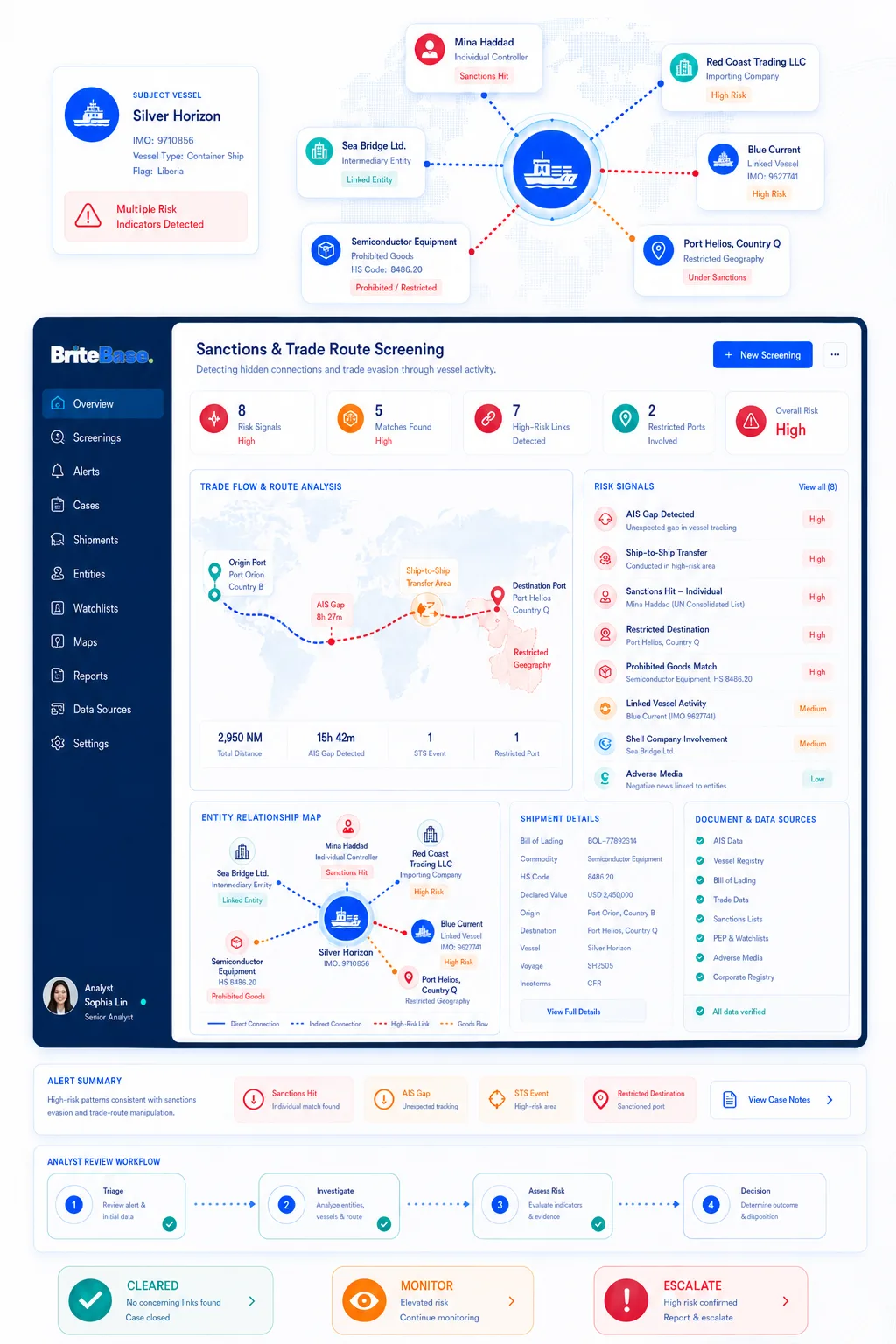
A payment enters the flow with originator, beneficiary and counterparty details.
Each party is matched against sanctions and watchlists in real time.
Entity resolution clears false matches before they hold the payment.
Clean payments proceed without interruption.
True hits hold the payment and route to review with evidence attached.
What powers the workflow?
Real-time party matching
Originators, beneficiaries and counterparties screened in-flow.
Agentic entity resolution
Clears false matches before they hold a payment.
Risk-based holds
Only true risk stops a payment.
Payment audit trail
Every hold and release recorded with evidence.
Frequently asked questions
How does BriteBase screen payments without slowing them down?
Screening runs inside the payment flow rather than as a separate step around it: originators, beneficiaries and counterparties are matched against sanctions and watchlists in real time as the payment moves, and agentic entity resolution clears false matches before they can hold a transfer. The real cost of payment screening is rarely the check itself. It is the false-positive holds, where a legitimate payment sits in a review queue while a customer waits and support tickets accumulate. Clearing name-variant and homonym noise before a hold is placed means clean payments proceed without interruption, and the payments that do stop are the ones carrying a genuine risk signal worth a human decision. The alternative approaches both fail in practice: batch screening discovers a sanctioned party only after settlement, and loose matching thresholds trade missed exposure for speed, neither of which survives an examination.
Which parties in a payment are screened?
The originator, the beneficiary and the counterparties in the flow are each matched against sanctions lists spanning OFAC, Canada, the EU, the UK, Australia and APAC regimes, including comprehensively sanctioned geographies, vessels, ports and restricted securities, plus trade restriction lists such as the US BIS lists, the World Bank Listing of Ineligible Firms and Individuals, and the Canada Export Controls List. Screening every party rather than just the customer side matters because exposure in a payment often sits on the far end of the transfer, with a beneficiary or intermediary the paying institution has never onboarded and holds no file on. Because payment screening runs on the same entity-resolution engine and the same data layer as customer and company screening, a party is evaluated against the same breadth of coverage regardless of which side of the payment it appears on, rather than payment fields being matched against a thinner list set than onboarding uses.
What happens when a payment is held?
Only true hits hold a payment, and each hold arrives with a plain-language rationale and the matching evidence already attached, so the reviewer starts from context rather than reconstructing why the payment stopped. The reviewer works the case in place: the match details, the conflicting evidence and the party history are in one record, and the release or escalation decision is documented as part of the same case rather than in a separate system. Every hold and release is recorded with its evidence and disposition, which is what lets payment screening stand up at examination time, since an examiner reviewing a sample of held payments can see specifically why each one stopped, what the reviewer considered, and why it was released or escalated. False matches cleared by entity resolution are also retained with the conflicting evidence that cleared them, so the record covers what did not stop the payment as well as what did.
See payment screening in action with BriteBase.
See our platform screen a live customer against global sanctions, PEP and adverse media data. Book a demo with our team.