

Prioritize alerts and close cases faster.
Score and route alerts by risk, then work each case with the evidence already attached, so investigators spend time on real exposure and leave a clean audit trail.
When every alert looks the same, investigators triage by hand and work low-value items before high-risk ones, which lengthens investigation cycles.
Evidence scattered across systems means re-keying and rebuilding context for each case, and audit trails that are hard to reconstruct.
How does BriteBase help with alert triage & case investigation?
Our agentic workflows score and prioritize alerts, assemble evidence and history for each case, and record every step, so investigations are faster and defensible by default.
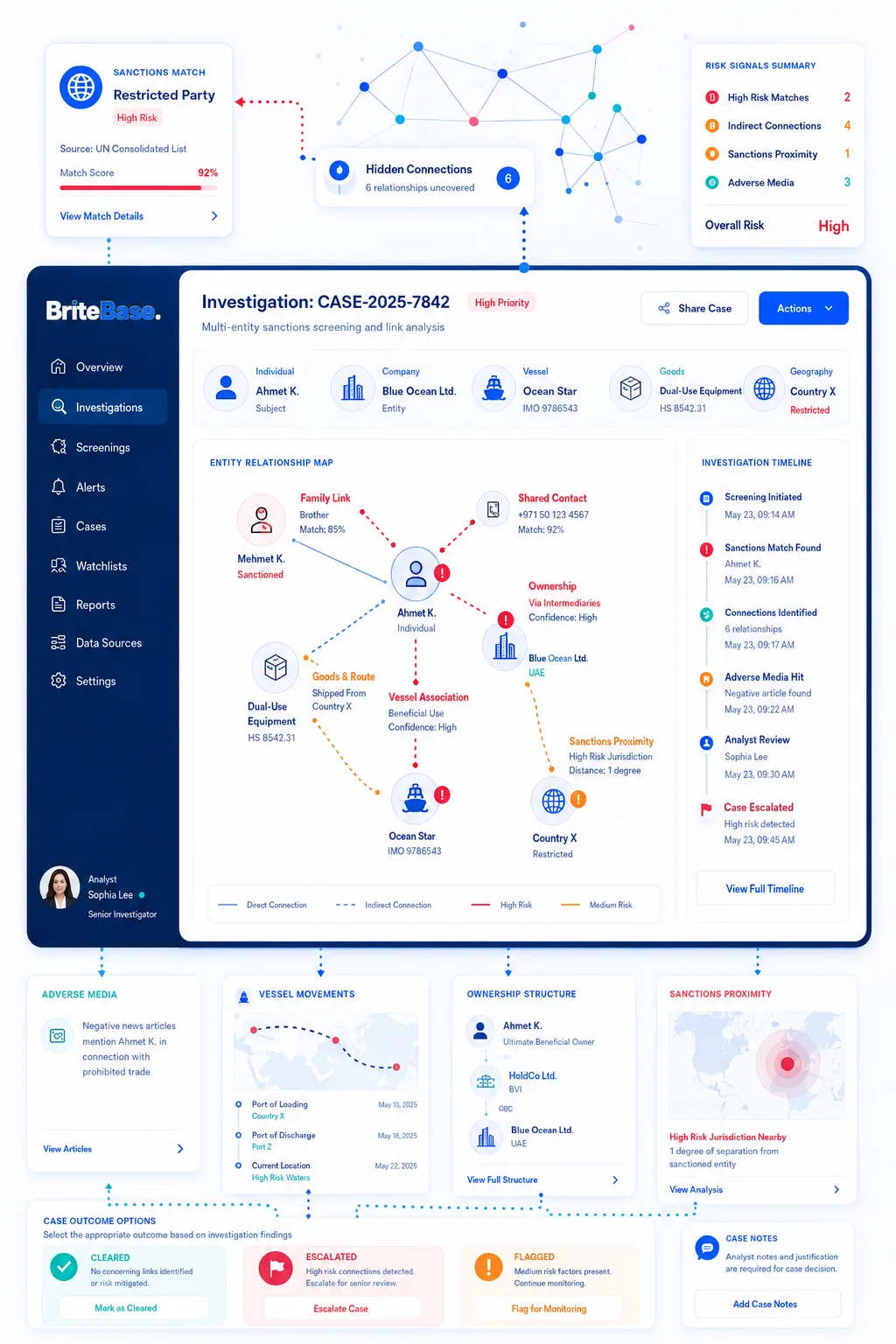
Alerts arrive scored and de-duplicated.
Risk-based routing orders the queue.
Each case opens with evidence and history attached.
Investigators document the decision in place.
The full case record is retained for examination.
What powers the workflow?
Risk-based prioritization
Highest-risk cases first.
Evidence assembly
Context attached automatically.
Case history
Every step recorded.
Examiner-ready
Complete records by default.
Frequently asked questions
How does BriteBase prioritize alerts?
Alerts arrive scored and de-duplicated, and risk-based routing orders the queue so investigators work the highest-risk cases first, rather than triaging an unordered queue by hand where a low-value alert that happened to arrive earlier gets worked before a genuinely dangerous one that arrived later. Scoring draws on the same signals that generated the alert in the first place, whether that was a screening hit, a fraud-risk flag, or an ongoing-monitoring change, so the priority order reflects the actual underlying risk rather than simply the order alerts happened to be generated in. De-duplication also matters at this stage: without it, the same underlying risk surfacing across multiple related alerts, for example several entities in one corporate structure, would occupy multiple slots in the queue instead of being recognized and worked as the single connected case it actually represents.
What makes investigations faster?
Each case opens with evidence and history already attached, so investigators stop re-keying and rebuilding context from scratch for every case and can instead document the decision directly in place, working from a case that already contains the screening result, the entity-resolution reasoning behind it, and any prior history on that same party. Without this, a meaningful share of investigation time is typically spent simply reassembling context that already existed somewhere else, in a different system or different reviewer notes, before the actual investigative judgment can even begin. Having that context pre-attached does not remove the judgment an investigator applies to the process, it removes the redundant reconstruction work that judgment previously depended on, so the time an investigator spends is concentrated on the decision itself rather than on gathering the inputs to that decision.
Is the case record examiner-ready?
Yes. Every step is recorded and the full case record is retained, so investigations hold up by default at examination time rather than requiring a separate documentation effort after the fact to reconstruct what happened and why. This includes the original alert, the evidence and history it opened with, the risk score and routing decision behind its priority, and the documented disposition an investigator files, all as one connected record rather than pieces scattered across the systems that touched the case along the way. Examiners specifically look for evidence that a firm actually followed its stated process, not just followed on real cases, not just that a process exists on paper, and a complete, connected case record is what lets that be demonstrated directly rather than reconstructed under time pressure during an active examination.
See alert triage & case investigation in action with BriteBase.
See our platform screen a live customer against global sanctions, PEP and adverse media data. Book a demo with our team.