

Monitor the whole book, continuously.
Risk does not stop at onboarding. Our platform re-screens your customer book automatically as sanctions lists, PEP status and adverse media change, and raises only the alerts that matter.
A customer cleared at onboarding can become a sanctions or PEP match later. Without continuous monitoring, that change goes unseen until it is a problem.
Periodic batch re-screening is slow and generates large alert spikes full of false positives, which overwhelm the team and delay the genuine hits.
How does BriteBase help with ongoing monitoring?
Our screening platform monitors continuously and applies agentic entity resolution to every change, so alerts are scored and de-duplicated as they arrive. The team sees a steady, prioritized queue instead of a periodic flood.
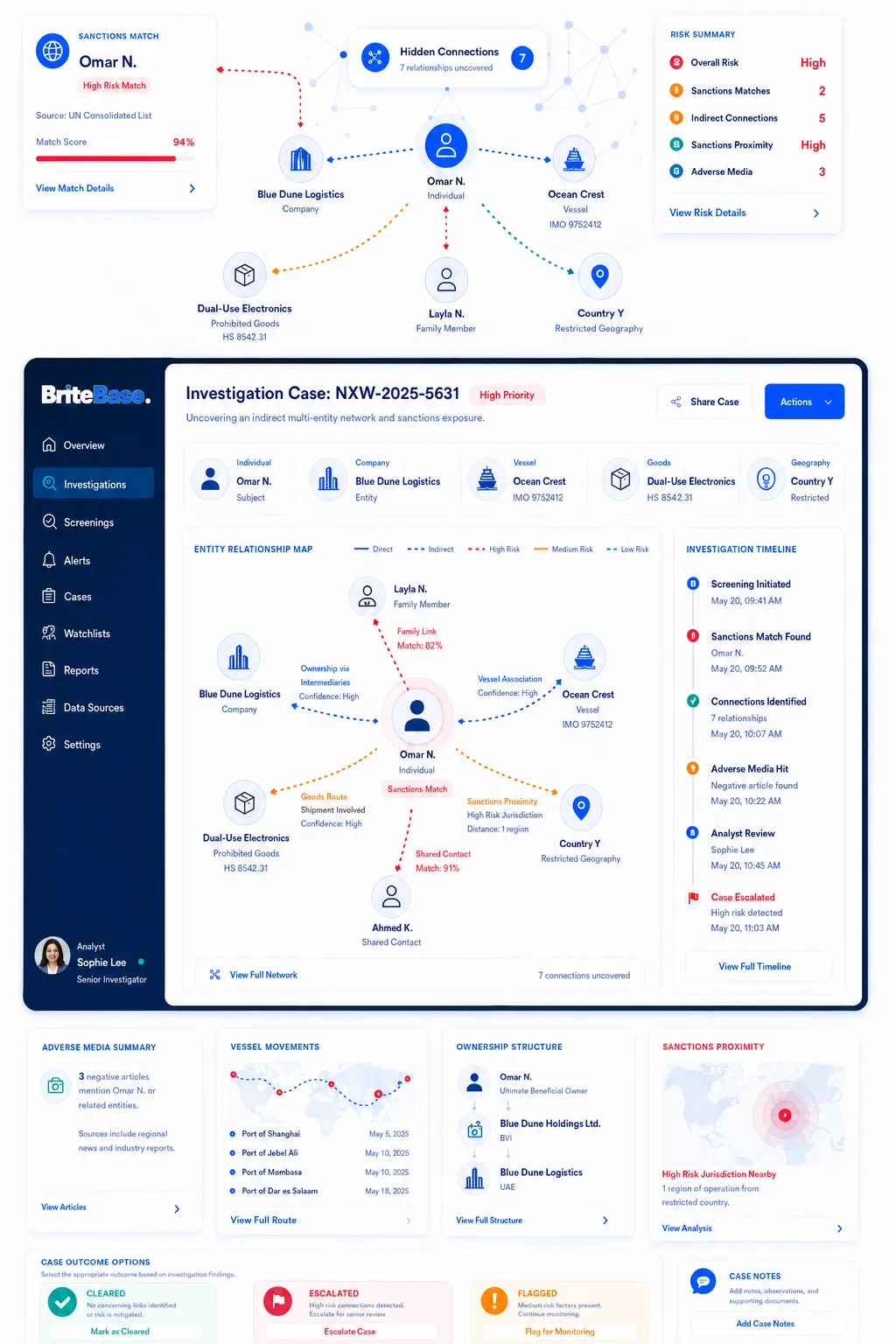
Customers are enrolled in continuous monitoring after onboarding.
Lists, PEP data and media are refreshed regularly.
Changes are matched against the book in real time.
Entity resolution scores and de-duplicates new alerts.
Prioritized alerts route to review with evidence and history.
What powers the workflow?
Continuous re-screening
Automatic monitoring as data changes.
Agentic entity resolution
Keeps the alert queue clean.
Risk prioritization
Surfaces the highest-risk changes first.
Audit trail
Every alert and disposition recorded.
Frequently asked questions
What is ongoing AML monitoring?
Continuous re-screening of your existing customer book as sanctions lists, PEP status and adverse media change, so a customer who becomes a match after onboarding is caught when the change happens rather than at the next scheduled batch cycle, which could be weeks later. Risk does not stop accumulating at the moment a customer is first cleared: a person can become politically exposed, a company can come under new ownership that triggers the 50% Rule, or adverse media can surface about a previously clean customer at any point during the relationship. Ongoing monitoring exists specifically to catch these changes in the gap between onboarding and whatever periodic review cycle a firm might otherwise rely on. Because monitoring runs on the same entity-resolution engine as onboarding screening, a new match surfaced during monitoring is scored and de-duplicated with the same rigor as a first-time screen, not treated as a lower-priority afterthought.
How is this better than periodic batch re-screening?
Batch re-screening produces large alert spikes full of false positives every time it runs, because an entire customer book is matched against updated lists all at once rather than continuously, and any list update that affects common names creates a flood that overwhelms the team on review day and then goes quiet until the next batch. Our screening system monitors continuously and applies agentic entity resolution to every change as it happens, so the team sees a steady, manageable, prioritized queue instead of a periodic flood followed by a lull. This also closes the exposure window that batch cycles leave open: a customer who becomes a sanctions match the day after a batch run would otherwise go undetected until the next scheduled cycle, which could be weeks away, whereas continuous monitoring catches that change close to when it actually occurs, which is when the exposure is most actionable.
Is there an audit trail for monitoring alerts?
Yes. Every alert and disposition is recorded, giving a clear, examiner-ready history of how risk on the book was detected and handled, not just a log of which alerts fired but a record of what a reviewer decided and why for each one. Examiners tend to look closely at how a firm handles risk that emerges mid-relationship, after the initial onboarding decision was already made, since that is where gaps in a compliance program are most likely to show up. The same case-record structure used for onboarding screening applies here, so a monitoring alert and an onboarding hit are documented with the same rigor and are retrievable using the same process, rather than monitoring being treated as a lighter-weight, less-documented workflow than the initial screen.
See ongoing monitoring in action with BriteBase.
See our platform screen a live customer against global sanctions, PEP and adverse media data. Book a demo with our team.