
Screen the business and its owners as one connected entity.
Screen businesses and their beneficial owners as one connected entity, so exposure across owners, aliases and related parties, including deep-tier ownership under the 50% Rule, is visible in a single record.
Screening a business by name alone misses risk that sits with its owners, aliases and connected parties.
KYB and beneficial ownership data are often worked across spreadsheets and separate tools, so connected exposure never comes together.
How does BriteBase help with entity screening?
Our screening system links entities, owners and related parties, screens them together, and resolves duplicates into one record, so the full picture is visible and documented.
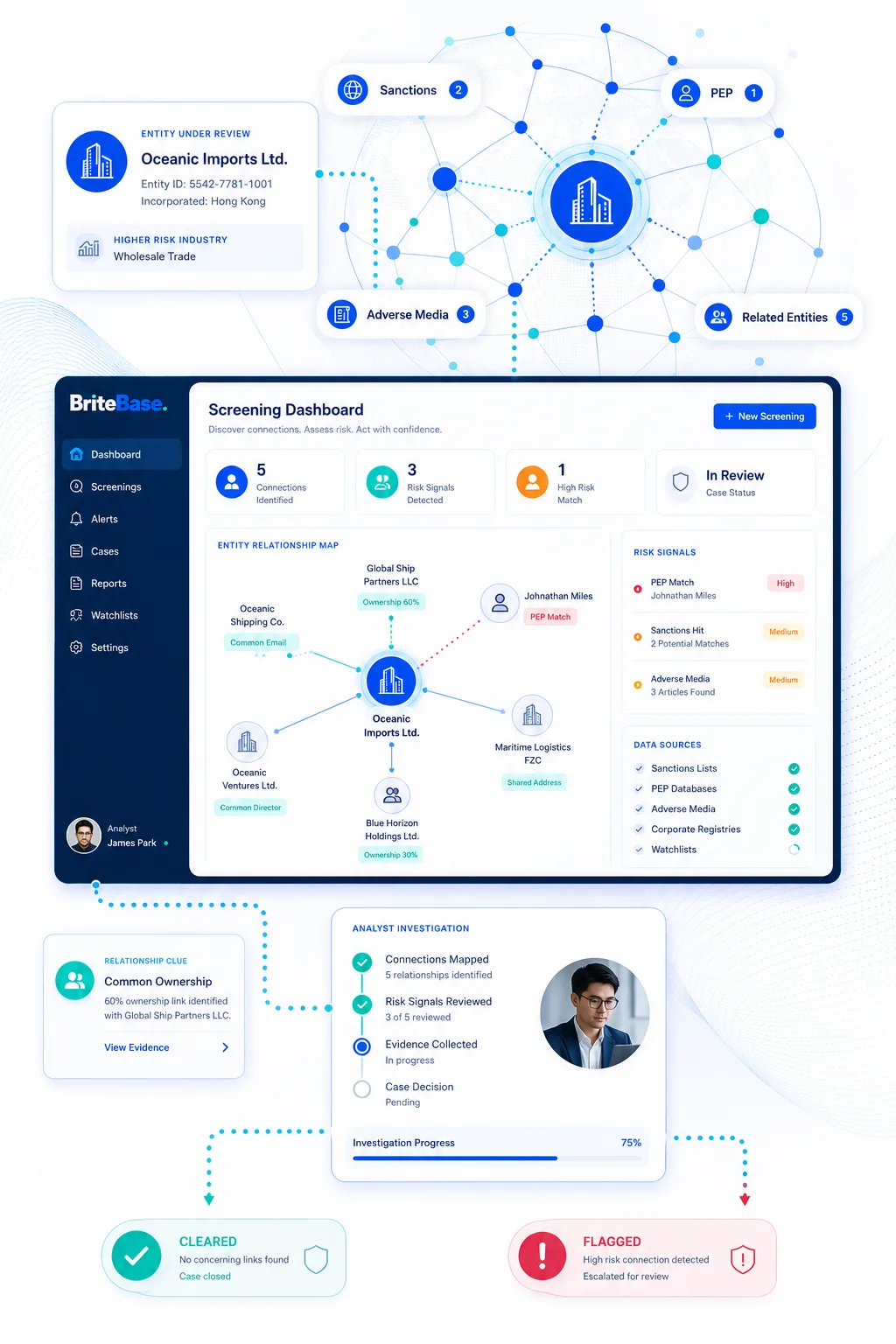
A business and its beneficial owners are identified.
Entities and related parties are linked.
All parties are screened against global lists and media.
Entity resolution clears duplicates across the structure.
Connected exposure is captured in one record.
What powers the workflow?
Beneficial ownership
Owners screened with the entity.
Entity linking
Aliases and related parties connected.
Full screening
Sanctions, PEP and adverse media.
One record
Connected, audit-ready evidence.
Frequently asked questions
What is entity and KYB screening?
Screening a business and its beneficial owners as one connected entity, so exposure across owners, aliases and related parties is visible in a single record rather than missed by checks that only screen the business name itself. A business can be entirely clean on paper while one of its beneficial owners carries direct sanctions exposure, or while ownership structure triggers the 50% Rule through a majority stake held by a sanctioned party several layers up the chain; a name-only check of the business alone would surface none of this. Entity screening deliberately links the business, its owners and related parties together before screening runs, so exposure anywhere in that connected structure is caught rather than only exposure attached to the name of the business itself. This is what KYB is meant to accomplish in principle, but is often handled inconsistently when ownership data lives in spreadsheets rather than a connected system.
Does it cover beneficial ownership?
Yes. Owners and related parties are linked to the entity and screened together against sanctions, PEP and adverse media, and captured as one connected, audit-ready record, rather than beneficial ownership being tracked separately from the screening result in a different system or a manual spreadsheet. This connection is what allows exposure created through ownership, rather than through the direct name of the business itself, to actually surface: a beneficial owner who is themselves a PEP, or who has adverse media associated with them, becomes visible as exposure on the business relationship even though the business itself triggered no direct match. Capturing all of this as one record also means an examiner reviewing the business relationship sees the full ownership-and-screening picture in a single place, rather than having to separately request and reconcile beneficial-ownership documentation against a screening result that was generated independently of it.
How does it reduce false positives across a corporate structure?
Agentic entity resolution clears duplicates across the structure, so connected exposure comes together into one assessment without each alias, subsidiary and related party independently generating its own redundant alert for what is, underneath, the same underlying risk. Corporate structures are especially prone to alert duplication without resolution: a single beneficial owner connected to multiple entities in a group, or a business operating under several trade names, can otherwise trigger the same underlying match repeatedly across every entity and alias it touches, multiplying review effort without adding any new information. Resolution recognizes that these are manifestations of one connected risk rather than several independent ones, consolidating them into a single assessment a reviewer can act on once, rather than working through a redundant version of the same finding attached to every entity in the structure it happens to reach.
See entity screening in action with BriteBase.
See our platform screen a live customer against global sanctions, PEP and adverse media data. Book a demo with our team.