

PEP screening with tier and relationship context.
Identify politically exposed persons with tiered classification and relationship context, so reviewers can judge real exposure instead of clearing a wall of generic flags.
Flat PEP flags treat a head of state and a distant associate the same way, and common names generate large volumes of low-value hits.
Without tiering and entity resolution, PEP screening produces noise that buries the exposure that actually warrants enhanced due diligence.
How does BriteBase help with pep screening?
Our screening platform classifies PEP exposure by tier and relationship, resolves entities to clear duplicates, and ships each hit with the context a reviewer needs to make a call they can support.
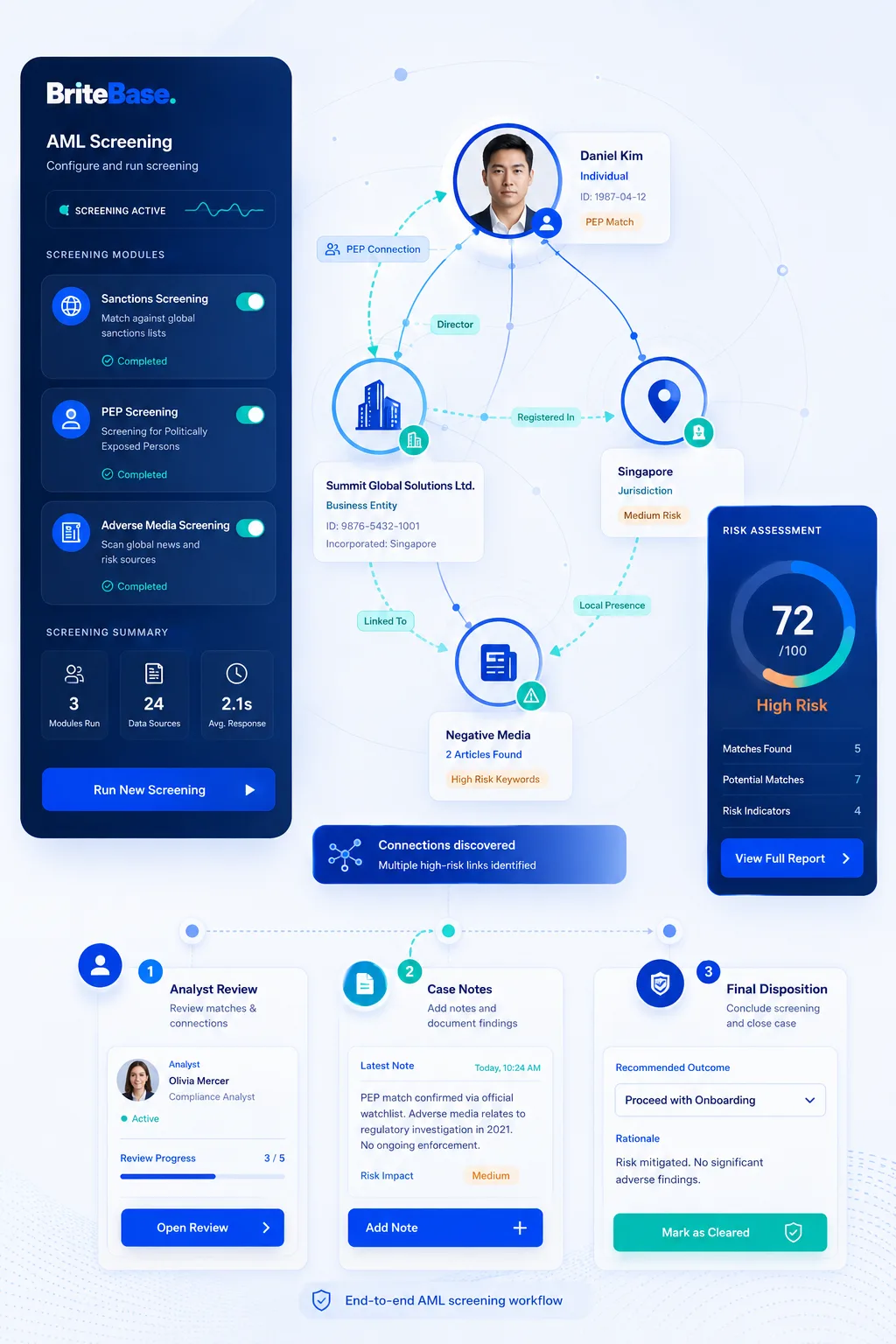
A customer is screened against PEP data.
Matches are classified by tier and relationship.
Entity resolution clears duplicates and homonyms.
Exposure is scored and prioritized.
Reviewers act with context and an audit trail.
What powers the workflow?
Tiered PEP classification
Exposure graded, not flattened.
Agentic entity resolution
Clears homonyms and duplicates.
Relationship context
Roles and connections included.
Documented decisions
Each hit carries a rationale.
Frequently asked questions
What is PEP screening?
Screening customers against politically exposed person data to identify exposure that may warrant enhanced due diligence, covering individuals who hold, or have held, prominent public roles along with their relatives and close associates. Our screening system classifies PEP exposure by tier and relationship instead of applying a flat yes-or-no flag, because a head of state and a distant, several-times-removed associate of a mid-level official carry meaningfully different risk despite both technically qualifying as PEP-adjacent under a flat definition. Tiered classification means a reviewer can see not just that a match occurred but how significant the underlying exposure actually is, which is the information that determines whether enhanced due diligence, or no action at all, is the right response. This runs on the same data layer as sanctions and adverse-media screening, so a PEP match can be considered alongside any other exposure the same party carries, rather than in isolation.
How does tiered PEP classification help?
Flat PEP flags treat a head of state and a distant associate the same way, which buries the exposure that actually warrants scrutiny inside a much larger volume of low-value matches on common names, since PEP definitions typically extend to relatives and associates several relationships removed from the actual public official. Tiering plus relationship context lets reviewers judge actual exposure directly, distinguishing a Tier 1 direct match on a senior official from a Tier 3 match on a distantly connected associate, rather than treating both as equally urgent simply because both technically cleared the PEP threshold. This is what lets an enhanced due diligence decision withstand examination: a reviewer who escalated a Tier 1 match and cleared a Tier 3 one with lower relationship proximity can point to a specific, documented reason for treating them differently, rather than having applied the same flat rule to both and hoping it holds up.
Does agentic entity resolution apply to PEP hits?
Yes. Agentic entity resolution clears duplicates and homonyms on common names, which matters especially for PEP screening because politically exposed person lists frequently contain names that are common in their country or region, producing a disproportionate share of homonym-driven false positives compared with sanctions lists alone. Without resolution, a common name shared by a Tier 1 PEP and thousands of unrelated customers would generate a match on every one of them, burying the one genuine PEP relationship inside noise that a reviewer has to manually clear every time. With resolution applied, the PEP queue reflects real exposure rather than volume, so the tiering and relationship context described above are actually being applied to matches worth reviewer attention, not diluted across a queue where most entries were never going to be genuine PEP hits in the first place.
See pep screening in action with BriteBase.
See our platform screen a live customer against global sanctions, PEP and adverse media data. Book a demo with our team.