

Screening that finds real risk, not false positives.
Our platform screens every customer, company and payment against sanctions, trade restriction, PEP and adverse media data, then lets agentic workflows evaluate context and resolve entities so your analysts review real risk instead of noise. Designed to reduce false positives by up to 80%, with a plain-language rationale on every hit.
Why does traditional screening bury teams in alerts?
With name-only matching, the vast majority of alerts are false positives. Compliance teams spend their day clearing low-value alerts while real risk waits in the queue.
- 01
Alert overload
High match volumes from name-only screening flood the review queue and push onboarding decisions past SLA.
- 02
Stale and siloed data
Lists refreshed on a lag and tools that do not talk to each other leave gaps a reviewer has to close by hand.
- 03
Weak prioritization
Without scoring, every alert looks the same, so analysts cannot tell a true hit from a homonym.
- 04
Thin audit trail
When a decision cannot be explained, examinations take longer and findings are harder to defend.
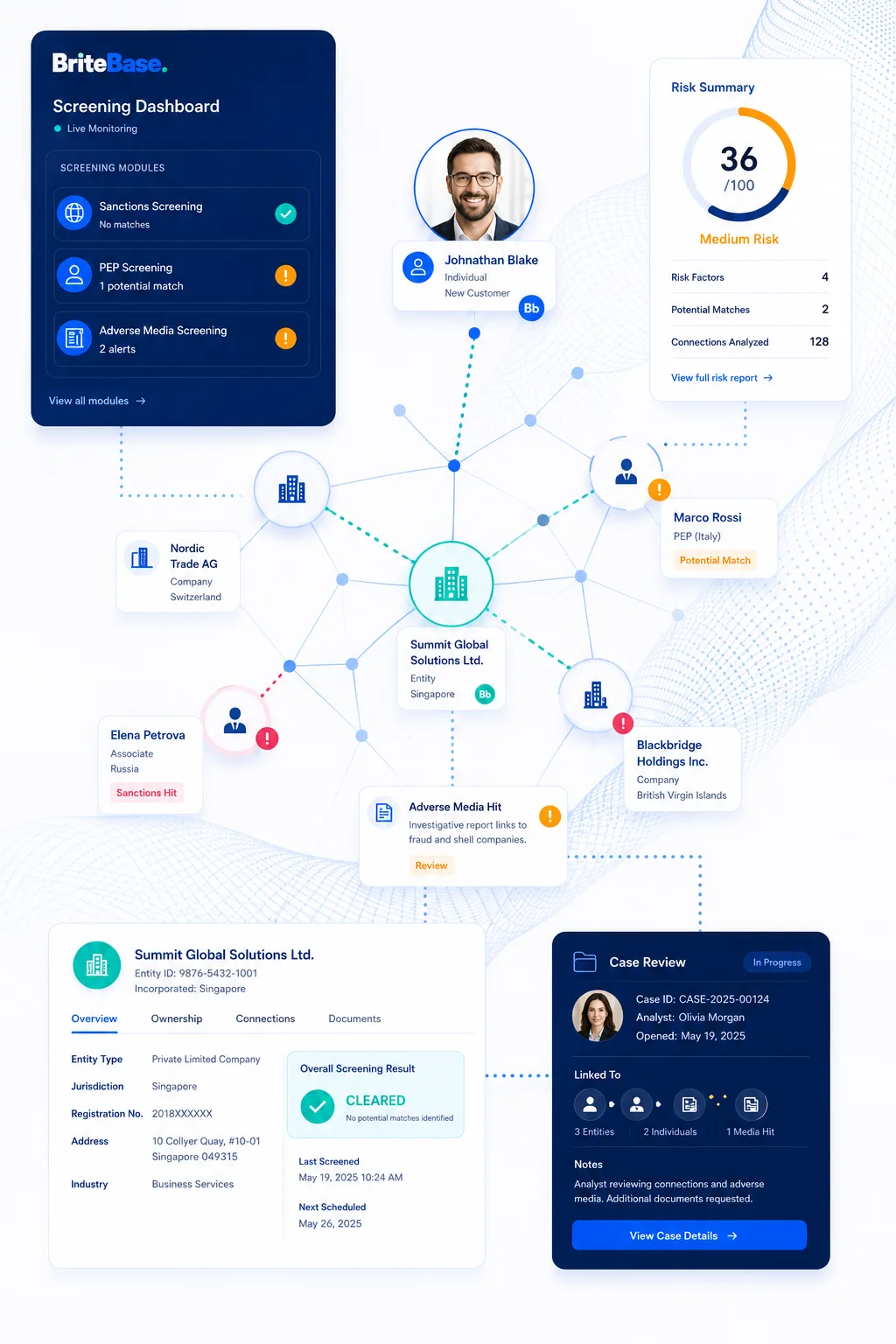
One engine, four kinds of screening
Regulated entities are required to conduct four kinds of screening. Our engine runs all four in one connected workflow, across customers, companies and payments, with entity resolution and ongoing monitoring underneath.
Sanctions screening
Match customers and payments against global sanctions lists, including comprehensively sanctioned geographies, vessels, ports and restricted securities.
Trade risk screening
Screen dual-use goods exposure against trade restriction lists: US BIS, the World Bank ineligible list and the Canada Export Controls List.
AML screening
Tiered PEP, RCA and HIO exposure with relationships and roles, not a flat flag.
Reputational risk screening
Relevant adverse media with a source citation on every finding.
Agentic entity resolution
Agentic workflows evaluate context and collapse near-duplicate matches into one scored identity, automatically.
Ongoing monitoring
Re-screen customers, companies and payments automatically as lists, media and risk profiles change, with an explanation of what changed.
Built for defensible decisions
The old way
The BriteBase way
Explainable, configurable and audit-ready
Built so every decision can be defended and every workflow tuned to your risk appetite.
Explainable decisions
Every hit ships a reason a reviewer and an examiner can both read.
Audit-ready case history
Alerts, evidence and dispositions captured as one connected record.
Configurable workflows
Tune thresholds, lists and routing to your risk appetite.
Frequently asked questions
How does BriteBase reduce AML false positives?
Agentic entity resolution scores identity coherence and collapses near-duplicate matches across spelling variants, transliterations and homonyms before an analyst ever sees them. With traditional name-only screening, the vast majority of alerts are false positives, which means a single real customer can surface as a dozen or more separate alerts across sanctions, PEP and adverse-media lists. BriteBase is designed to cut that noise by up to 80% without dropping true risk, so the alerts that reach a reviewer are the ones actually worth their time. The same engine covers customer, company and payment screening in one workflow, so entity resolution runs consistently across every screening surface rather than being reapplied differently by each downstream tool. Every hit that survives resolution still carries a plain-language rationale and an evidence trail, so clearing noise never comes at the cost of losing the audit record an examiner would expect to see.
What lists does BriteBase screen against?
Sanctions coverage spans the major regimes: OFAC in the US, Canada, the EU, the UK, Australia and APAC jurisdictions, including comprehensively sanctioned geographies, vessels, ports, restricted securities and the ownership exposure created by the 50% Rule. Trade restriction coverage adds the US Bureau of Industry and Security lists, the World Bank Listing of Ineligible Firms and Individuals, and the Canada Export Controls List. Coverage runs alongside tiered PEP data, which classifies politically exposed person exposure by tier and relationship, covering relatives, close associates and heads of international organizations, and relevant adverse media with source citations attached to every finding. Because sanctions, trade restriction, PEP and adverse-media data all run through the same entity-resolution layer, a match on any one list is scored against the same resolved identity as the others, rather than separate systems each producing their own uncoordinated alert for the same underlying party.
Is every hit explainable for audits?
Yes. Each hit ships a plain-language rationale, not just a confidence score, explaining specifically why a match was escalated, for example an exact name and date-of-birth match against a Tier 2 PEP record. Alerts, evidence and dispositions are captured as one connected case record rather than scattered across separate systems, so reconstructing why a decision was made months later does not require rebuilding context from scratch. Thin explanations, not thin coverage, are usually what lengthens an examination, whether the examiner is FINTRAC in Canada, FinCEN in the US, the FCA in the UK, or a national supervisor in the EU: an examiner accepts a clear rationale far faster than a bare match score. The same record structure applies whether the hit came from real-time onboarding screening or from ongoing monitoring picking up a change months after a customer was first cleared, so the audit trail stays consistent across the full customer lifecycle rather than fragmenting by screening trigger.
Does it screen at onboarding and on an ongoing basis?
Both, on the same engine rather than two separate systems bolted together. Onboarding screening runs in real time against sanctions, PEP and adverse media the moment a customer, company or payment enters the flow, so a decision is available before the account opens rather than after a batch job runs overnight. Ongoing monitoring then re-screens the same customer book continuously as lists, media and risk profiles change, so a customer cleared at signup who later becomes a sanctions or PEP match is caught when the change happens, not at the next scheduled batch cycle weeks later. Because both modes share the same entity-resolution logic, a customer does not get re-evaluated by different rules depending on whether the trigger was onboarding or an ongoing list update, which keeps the false-positive reduction and the audit trail consistent across the entire relationship, not just at the start of it.
Bring AML Screening into your risk operations.
See our platform screen a live customer against global sanctions, PEP and adverse media data. Book a demo with our team.