

Adverse media screening that surfaces signal, not noise.
Screen customers against negative news and surface the articles that actually indicate risk, each with a source citation, so reviewers spend time on relevant findings.
Open-web adverse media screening returns huge volumes of weakly related articles, and a single common name can pull in stories about other people entirely.
Without relevance filtering and agentic entity resolution, reviewers wade through irrelevant results and still risk missing the article that matters.
How does BriteBase help with adverse media screening?
Our agentic workflows filter adverse media for relevance, tie findings to the right entity, and present each result with a citation, so the review is short and fully sourced.
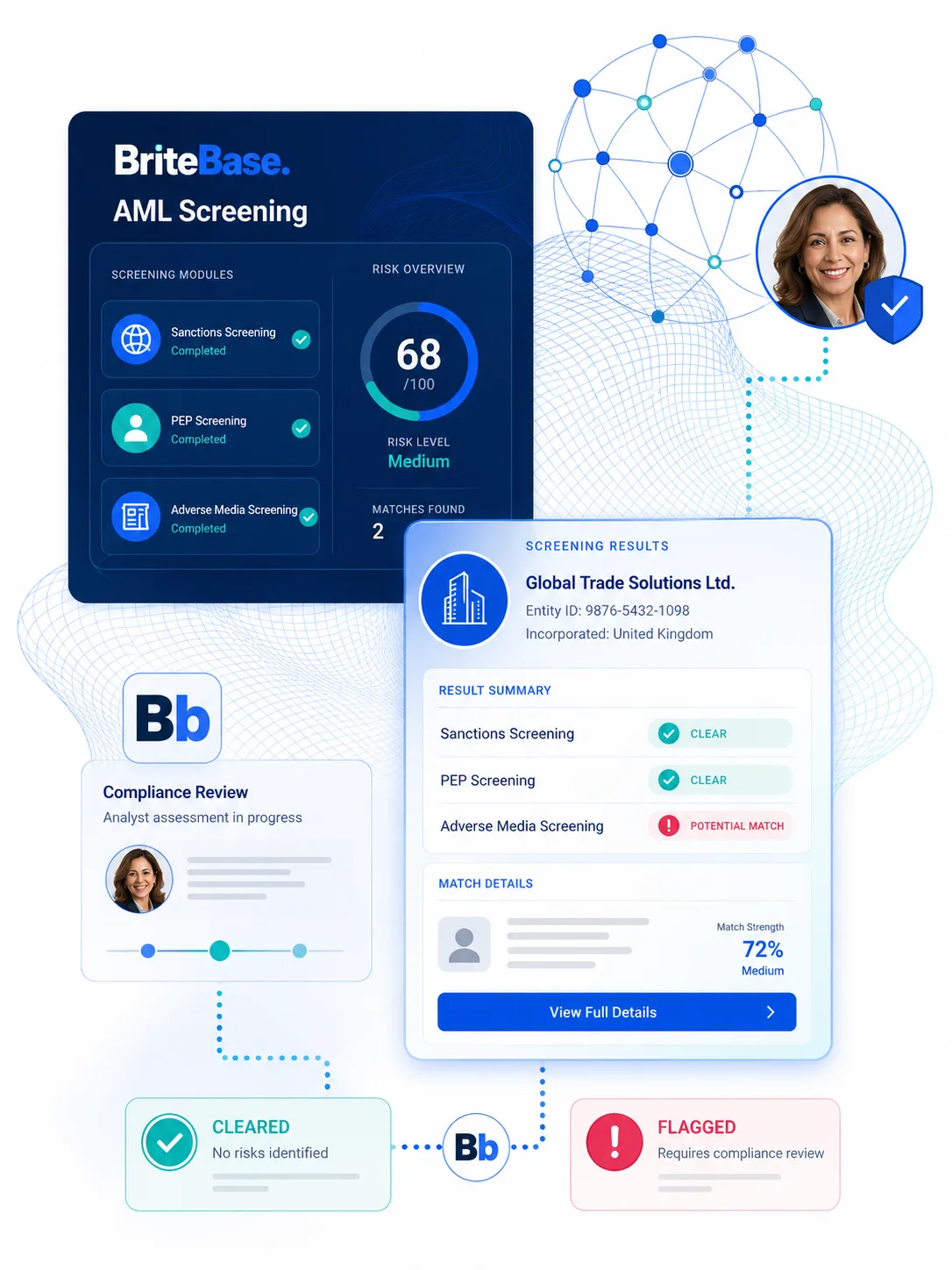
A customer is screened against adverse media.
Results are filtered for relevance and risk.
Agentic entity resolution ties findings to the correct party.
Relevant findings are presented with citations.
Reviewers act on a short, sourced list.
What powers the workflow?
Relevance filtering
Cuts weakly related results.
Source citations
Every finding is citable.
Entity matching
Findings tied to the right person.
Defensible review
Short, sourced, audit-ready.
Frequently asked questions
What is adverse media screening?
Screening a customer against negative news to surface stories that indicate financial-crime or reputational risk, covering coverage of fraud, sanctions evasion, corruption and similar conduct rather than general negative press unrelated to financial crime. Our screening system filters results for relevance so reviewers act on signal, not noise, which matters because open-web adverse media screening without relevance filtering tends to return large volumes of only weakly related coverage, much of it about entirely different people who happen to share a name with the customer being screened. Filtering for relevance means the results a reviewer sees are the ones that plausibly concern the actual party under review, tied to financial-crime-relevant conduct specifically, rather than a raw list of every news article containing a matching name regardless of topic or subject. This runs on the same underlying data and entity-resolution layer as sanctions and PEP screening.
How does BriteBase cut adverse media noise?
Open-web adverse media returns large volumes of weakly related articles, and common names pull in stories about entirely unrelated people who simply share that name with the customer being screened, which is the single largest source of adverse-media false positives in practice. Relevance filtering and agentic entity resolution tie findings to the right party specifically and drop the noise, distinguishing an article that genuinely concerns the screened customer from one that concerns a different person with a coincidentally similar name and profile. This distinction is what keeps adverse-media review manageable at volume: without it, a common name generates a review burden proportional to how many unrelated news stories exist about anyone sharing that name, rather than proportional to the actual risk the specific customer being screened carries. Each surviving finding is presented with a source citation, so the relevance judgment itself is checkable, not just asserted.
Are adverse media findings sourced?
Yes. Every finding is presented with a source citation, so the review is short, sourced and audit-ready, meaning a reviewer, and later an examiner, can trace any adverse-media escalation back to the specific article or report that triggered it rather than relying on an unsourced summary. Adverse media is inherently more subjective than a binary sanctions-list match: two reviewers might reasonably disagree about how seriously to weigh a given news story, and having the actual source attached is what lets that judgment be reviewed and, if necessary, revisited later rather than being locked into whatever the original reviewer decided with no way to check the underlying material. Citations are attached automatically as part of the relevance-filtering process described above, so sourcing is not a separate manual step a reviewer has to perform after the fact.
See adverse media screening in action with BriteBase.
See our platform screen a live customer against global sanctions, PEP and adverse media data. Book a demo with our team.