

Onboard customers fast, without loosening controls.
Screen every new customer against sanctions, PEP and adverse media in real time, then approve low-risk customers instantly and route only edge cases to a reviewer.
New-customer onboarding has to satisfy two goals that usually pull against each other: approve good customers in seconds, and apply real AML controls. When screening is noisy, conversion drops and reviewers fall behind.
Name-only screening produces false positives on a large share of applicants, and every one of them pushes work into a manual queue that grows with volume and delays the customers waiting behind it.
How does BriteBase help with customer onboarding?
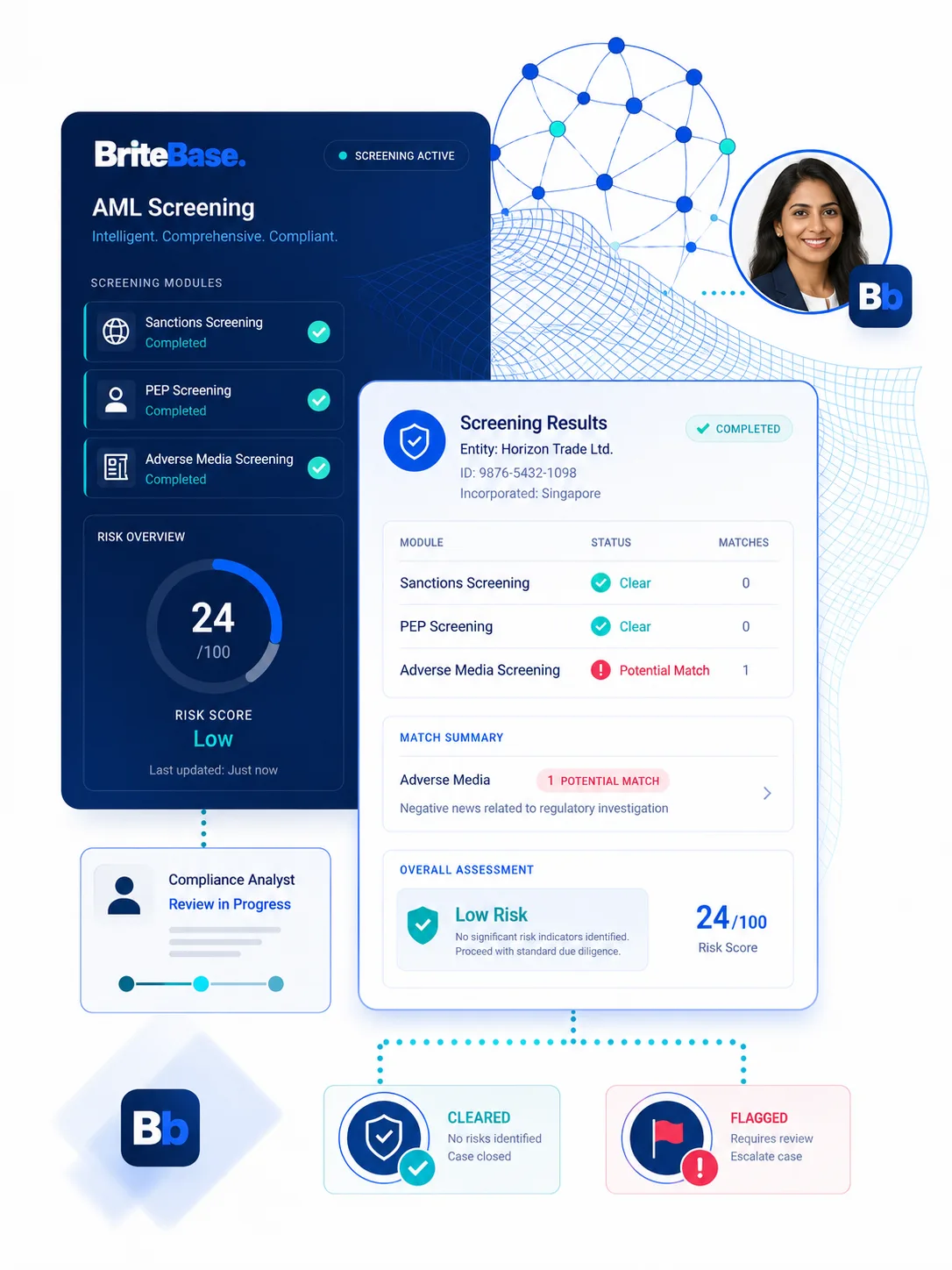
Our platform screens in one real-time step. Agentic entity resolution clears false positives before they reach a reviewer, and risk-based routing approves low-risk customers automatically. Only genuine edge cases are escalated, with the evidence already attached.
A new customer enters the onboarding flow.
The customer is screened against sanctions, PEP and adverse media in real time.
Entity resolution clears false positives and scores remaining risk.
Configurable screening profiles apply your risk-based rules to the result.
Low-risk customers are approved instantly; edge cases route to review with evidence.
What powers the workflow?
Real-time screening
Sanctions, PEP and adverse media at signup.
Agentic entity resolution
Clears false positives before review.
Configurable screening profiles
Match the checks to each customer segment.
Risk-based routing
Approve fast, escalate only what needs a human.
Frequently asked questions
How does BriteBase speed up onboarding without weakening controls?
Screening runs as one real-time step inside the onboarding flow, so a decision is available in the time it takes to complete signup rather than waiting on a separate compliance review. Agentic entity resolution clears false positives before they reach a reviewer, and risk-based routing approves low-risk customers automatically, so only genuine edge cases are escalated to a human. This is how speed and control improve together rather than trading off against each other: the controls are not loosened, they are applied more precisely, with the heaviest scrutiny reserved for the applications that actually carry risk signals worth reviewer time. Every new customer is still screened against sanctions, PEP and adverse media, with the evidence attached to whatever decision is made, whether that decision was automatic or escalated, so the speed never comes at the cost of the audit record an examiner would expect to see.
Can screening rules be tuned to our risk appetite?
Yes. Screening profiles, thresholds and suppression rules are configurable by the compliance team, so the checks applied to each customer segment reflect your documented risk-based approach rather than a single flat setting for every applicant. Different segments genuinely carry different risk at onboarding: a domestic retail customer and a cross-border business customer do not warrant identical scrutiny, and a configuration that treats them identically is either too heavy for one or too light for the other. Because configuration lives with the compliance team rather than in code, adjusting a threshold or adding a targeted suppression rule does not wait on an engineering release cycle, which is often where risk-based intentions stall in practice. Every configuration still produces the same explainable output: each screening result carries the matching and conflicting information behind it, so a tuned profile remains as defensible as a default one.
How much manual review does it remove?
By clearing false positives up front through entity resolution and approving low-risk customers automatically through risk-based routing, BriteBase is designed to cut false positives by up to 80% and route only genuine edge cases to a human reviewer. That reduction compounds at volume: with traditional name-only screening, the large majority of what a manual review queue processes is noise rather than real risk, and clearing that noise before it reaches a human is what actually shortens onboarding queues rather than just making them feel faster. The customers who do reach a reviewer arrive with the evidence behind their escalation already attached, so the manual review that remains is genuinely investigative work on cases that warrant it, not the repetitive clearing of matches that were never going to be true hits in the first place.
See customer onboarding in action with BriteBase.
See our platform screen a live customer against global sanctions, PEP and adverse media data. Book a demo with our team.